Choosing the Right Commercial Cleaning Provider in Adelaide (Without the Guesswork)
Selecting a cleaning partner shouldn’t feel like rolling the dice. The right provider protects your people, brand, and assets; the wrong one creates risk, rework, and cost blowouts. This guide gives Adelaide facility managers, strata managers, venues, and offices a practical, compliance-first way to evaluate providers—routine cleaning through to high-risk biohazard and emergency sewage clean-ups—so you can decide with confidence.
Start With Non-Negotiables
Licences, insurances, and safety systems are not “nice to have”—they’re the minimum.
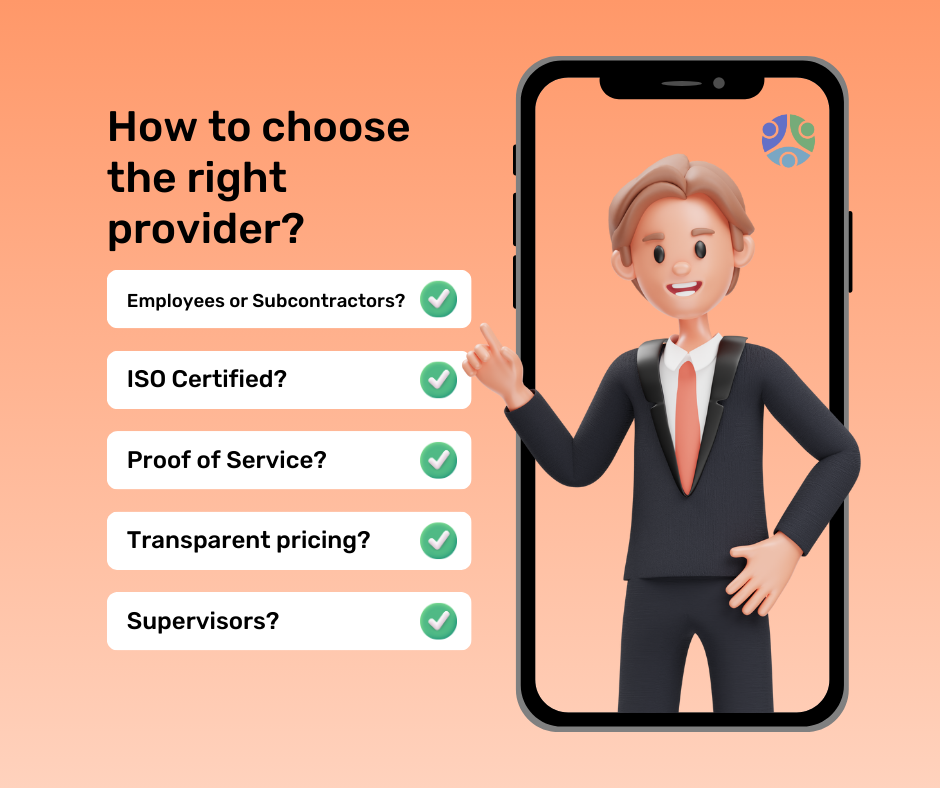
• ISO-aligned systems: Quality (ISO 9001), Environment (ISO 14001), Safety (ISO 45001). Ask for current certificates and scope of certification.
• Employee model vs subcontractors: Employees mean trained, insured, supervised teams on payroll. Subcontract chains can hide gaps in training, insurance, and accountability.
• WHS documentation: Risk assessments, SWMS for high-risk tasks, chemical register/SDS on file, and site-specific inductions.
• Insurance and screening: Public liability, workers compensation, police checks, and where relevant, vaccinations or clearances for sensitive sites.
• Waste and biohazard compliance: For Category 3 water or sharps, require documented waste streams and chain-of-custody.
Demand Evidence, Not Assurances
If it isn’t recorded, it didn’t happen. Require digital proof of service so you can verify performance and satisfy auditors and insurers.
• Photo logs and time-stamped attendance
• Itemised service reports tied to your scope
• ATP or equivalent surface hygiene verification where appropriate
• Corrective action tracking with close-out evidence
Check Operational Capability, Not Just Promises
A provider’s structure determines how they perform when something goes wrong.
• Supervision and escalation: Named site supervisor, escalation pathway, and response times in writing.
• Coverage and continuity: Relief staffing, leave coverage, and mobilisation plan for new sites.
• Training program: Documented onboarding, site-specific training, refreshers, and competency checks.
• Equipment and products: Fit-for-purpose machinery (e.g., HEPA filtration, microfibre systems, i-mops), with maintenance logs.
Pricing Should Be Transparent and Predictable
Low hourly rates often hide missing scope, rushed work, or cut-corners on safety. Insist on clarity.
• Line-by-line inclusions and exclusions, frequencies, and productivity assumptions
• After-hours, emergency, and public holiday rates stated up front
• Periodical works separated from daily tasks to avoid scope creep
• Variation triggers defined (e.g., change in headcount, area, or compliance level)
• Evidence of value: before/after metrics, audit scores, and complaint response times
Sector Fit Matters
Adelaide sites vary widely. Make sure the provider is fluent in your risks.
• Offices: Touch-point hygiene verification, secure key/code handling, minimal disruption cleaning routines
• Hospitality: Food-safe processes, grease and back-of-house controls, rapid spill response
• Industrial: Permit-to-work familiarity, confined space awareness, segregation of pedestrian/plant zones
• Biohazard and sewage: Category 3 water handling, containment, negative air/HEPA usage, ATP verification, waste tracking, clearance documentation
Interview Questions That Separate Claims From Capability
• Show me your ISO 9001/14001/45001 certificates and audit summaries.
• Who will be my on-site lead and who covers when they’re away?
• How do you prove attendance, scope completion, and cleanliness outcomes?
• Walk me through your incident response process and typical timelines.
• Provide a redacted clearance report from a biohazard/sewage job.
• What KPIs will you commit to and how often will we review them?
• How do you onboard a new site in the first 30 days?
• What is your data/privacy protocol for photos, keys, and alarm codes?
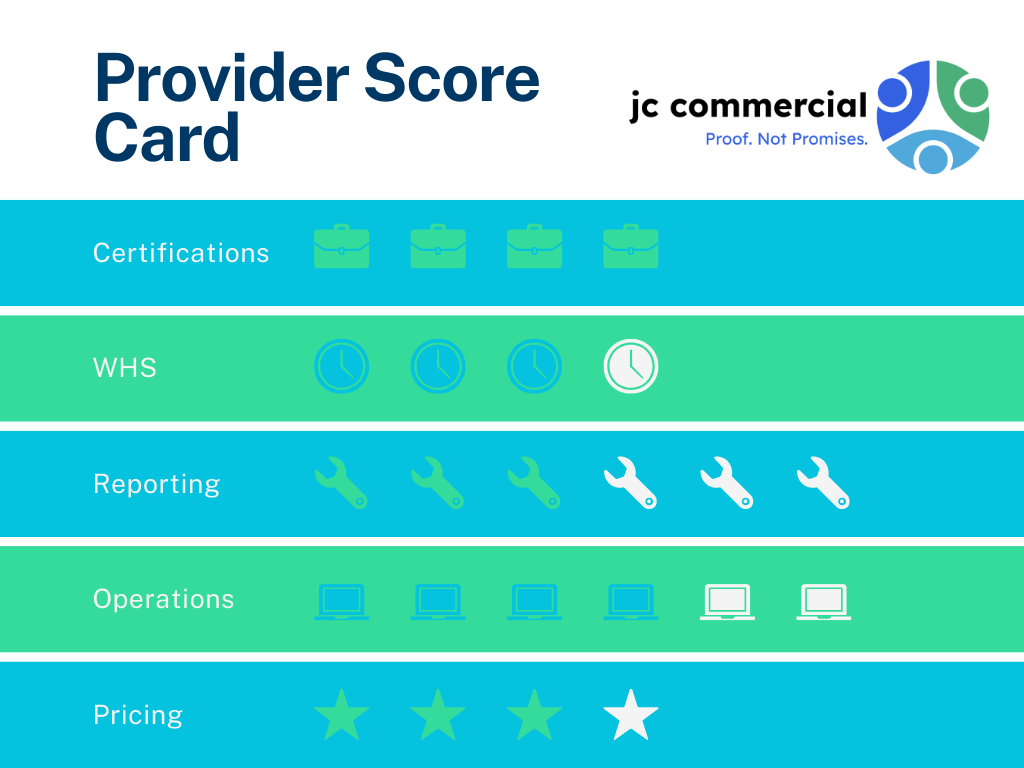
A Simple Scorecard You Can Use Today
Score each provider from 0–2 (0 = missing, 1 = partial, 2 = strong). Aim for 24+ overall.
• Certifications and WHS (max 8): ISO set, insurances, SWMS, SDS
• Evidence and reporting (max 6): photos/time-stamps, ATP when relevant, issue close-outs
• Operational capability (max 6): supervision, relief coverage, training, equipment
• Pricing clarity (max 4): itemised scope, clear variation rules, periodicals split
Totals guide selection—and keep every conversation grounded in facts, not sales talk.
Email us sales@dev.ishtiaquekhan.com
“Scorecard” for a copy
Red Flags To Avoid
• “We don’t need that” when you ask for SWMS, waste tracking, or hygiene verification
• Subcontractors performing core work without disclosure
• Vague quotes with bundled line items and no productivity assumptions
• No supervisor named; “call the office” for everything
• No documented onboarding or mobilisation plan
How JC Commercial Measures Up
JC Commercial is an employee-only, Adelaide-based team with triple ISO certification (9001/14001/45001). We deliver digital proof on every job, maintain sector-specific methods for offices, hospitality, industrial, and biohazard/sewage events, and price transparently with line-by-line scopes. Our mobilisation plans, site audits, and hygiene verification give you clear, defensible evidence for WHS and insurance.
Next Steps
If you’re comparing proposals now, send us your scope and site details for an apples-to-apples, line-item quote. If you’re building your first scope, we can draft it with measurable KPIs, an onboarding plan, and a review cadence so performance never drifts.